- Target: 100% renewable energy by 2022
- Status: In progress
- RES: Solar power and battery systems.
- Implementation: The north-eastern Victorian town of Yackandandah in Australia recently noted the production of 1GWh of locally generated renewable energy, thus reaching the half-way point of its transition to 100 per cent renewables by 2022. Led by community energy organisation Totally Renewable Yackandandah (TRY), the town has installed solar and some battery systems, on over half of its households and community buildings. TRY's second solar purchasing offer (with battery storage) was recently launched in partnership with Mondo Power, a subsidiary of network operator AusNet Services to help communities shift to renewables. Work is also underway on a state government funded mini-grid project which will trial the use of solar, storage, and smart controls to manage network security along a Single Wire Earth Return (SWER) power line. An earlier mini-grid in the town was installed in 2017, linking almost 200 homes fitted with a combination of rooftop solar, battery storage, and smart controls. Today, the town has two functioning micro-grids, allowing customers to share power amongst themselves. TRY is now working with the local community to set up a community owned energy retailer, which will help the town reach the 100 per cent target.
- Population: 950 (2011)
- Link: https://onestepoffthegrid.com.au/victorian-town-notches-up-1gwh-of-locally-generated-renewable-energy-on-road-to-100/
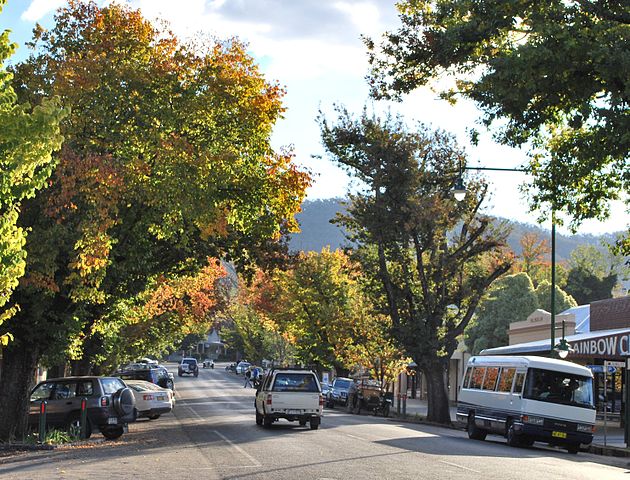
- © Mattinbgn CC BY-SA 3.0