Perpignan, France

Perpignan, France

  • Target: "Energy positive" city by 2015
  • Status: In progress
  • RES: Wind turbines, solar farm and rooftop solar PV
  • Implementation: Perpignan is a city and commune located in France near the Spanish border. In 2008, the City of Perpignan and the Perpignan Méditerranée Communauté d'Agglomération, a collection of 36 towns in the region, signed an agreement to make Perpignan an "energy positive" city by 2015 - that is, a city that generates more electricity with renewable sources than the citizens consume. Named the first Grenelle 2015 Agreement, it set out a vision to modify the city's approach to urban development by engaging in energy efficient housing, sustainable transportation, organic agriculture, local food production, air/water resource conservation, and environmental protection. The agreement also aims to ensure that each town maintains its identity, individuality, traditions and way of life, while the above measures are carried out. Part of the strategy is to make the people of the region "eco-citizens" by sharing information, developing school programs, and engaging the business community, etc. Specifically, the plan aims to generate 440,000 euros per year to cover residential needs with an investment of about 500 million euros, with a return on investment of between 10 and 15 years.

    In relation to the energy target, the plan includes a wind development zone for 41 wind turbines with a generating capacity of 294,000 MWh a year, which could cover 67% of the region's  electricity needs. The plan also aims to generate 48,000 MWh annually from rooftop solar photovoltaic installations on public buildings. Solar PV on private buildings covering around 120,000 square meters of roof space is envisioned, thereby providing 10% of the involved community's electricity demand.  To help support this goal, CEMOI, a leading producer and exporter of French chocolate, has invested in a solar production facility. Additionally, a solar park of approximately 100 hectares (over a third of a square mile) is to generate 42,000 MWh per year.

  • Population: 118,238 (2013)
  • Area: 68.07 km2 (26.28 sq mi)
  • Link: Perpignan Positive Energy Territory
Perpignan, France

Prato allo Stelvio (Prad am Stilfser Joch), Italy

Prato allo Stelvio, Alto Adige, Italy

  • Target: 100% renewable energy
  • Status: Achieved
  • RES: Biomass heating plant, 4 small hydroelectric plants, rooftop solar and a wind farm.
  • Implementation: In 2010, Prato allo Stelvia, a small Italian town in the mountains, won the RES Champions League title for having the best policies to promote renewable energy. Today, it has achieved 100% renewable energy self-sufficiency. The town has installed several renewable energy technologies, including a 1.4 MW central biomass heating plant, 4 small hydroelectric plants totaling just over 2 MW,  5.4 MW of rooftop solar power spread throughout the town, and a 1.2 MW wind farm. This energy mix has brought many benefits to the citizens of Prato all Stelvia. The air is free of pollution from conventional power plants, and utility bills have been reduced by 30-40%. Moreover, in 2003, when nearly all of Italy suffered a massive black out, the town fared well even though it was still connected to the national grid,  thanks to its efficient locally operated grid powered by renewable power plants.
  • Population: 3 603 (2018)
  • Area: 51,49 km²
  • Link: https://www.e-werk-prad.it/it/
Prato allo Stelvio, Alto Adige, Italy

Rietberg, Germany

Rietberg, Germany

  • Target: Energy self – sufficiency within the electricity sector by 2030
  • Status: In progress
  • RES: Biogas plant, geothermal energy system and solar tracker.
  • Implementation: In 2011, the town of Rietberg in Germany compiled a communal climate protection concept together with the public to outline a wide range of renewable energy, energy efficiency and energy saving initiatives. The city council also decided to fix the goal of achieving energy self–sufficiency within the electricity sector by 2030. To reach the target, the town has implemented several RE projects. The flagship of Rietberg is the unique “Klimapark Rietberg”. The Information- and Technology-Park exhibits several renewable energy facilities, like a walk-in biogas plant, a geothermal energy system and a solar tracker. Klimapark Rietberg is located in an old horticultural area and has involved 18 project partners from various business, science and environmental organizations. In 2013, Klimapark was awarded  the 'Place of Progress' from Nordrhein-Westfalen and UN-Decade Project of Education for Sustainable Development.
  • Population: 29,444 (2016)
  • Area: 110.37 km2 (42.61 sq mi)
  • Link: (In German) https://www.rietberg.de/rathaus/klimaschutz-energie
Rietberg, Germany

Ringkøbing-Skjern, Denmark

Gammelsogn, Ringkøbing Skjern, Denmark

  • Target: 100% renewable energy by 2020
  • Status: In progress
  • RES: Bio-energy, wind power, new plus-energy buildings, hydrogen vehicles and hydrogen service stations, and solar power.
  • Implementation: Ringkøbing-Skjern is the largest municipality in Denmark, established in 2007. At its conception, the municipality only met 20% of its energy from renewable sources. However, Ringkøbing-Skjern aims to produce within its boundaries enough renewable energy to cover all consumption by its citizens and businesses by 2020. It has set out an Energy 2020 plan, which aims to have local people, businesses, institutions and non-profits implement energy projects, from testing to development to implementation, in order to stimulate sustainable economic growth within the municipality.

    The Energy 2020 plan includes a top-down and bottom-up leadership structure. From the top, the 100% plan would be lead by the Energy Board, which is made up of local business and organisation representatives, along with municipal officials and staff. The Board would advise the local governing Council, which appoints a Secretariat to coordinate the effort and provide information, marketing and an energy action plan. From the community level, projects of all sizes would be implemented by local citizens, businesses and non-profit organizations. Impetus to engage would be motivated by expected energy savings, environmental benefits, and economic opportunities.

    In relation to the energy target, the plan envisages different types of renewable installations. Ringkøbing-Skjern will take advantage of its large land area and the energy that can be made from farm animal waste and plants. New wind turbines are expected to generate twice as much power as the whole municipality consumes. New buildings will be "plus energy," that is, able to generate more energy than the use. The Council will continue to operate hydrogen vehicles and hydrogen service stations, and public and individual transport are to run on biofuel and electricity. Other technologies currently being used include thermal heat, fjord heat, solar power, solar cells, and wave energy.

  • Population: 57,148 (2014)
  • Area: 1,494.56 km² (577.05 sq mi)
  • Link: https://www.energi2020.dk/english
Gammelsogn, Ringkøbing Skjern, Denmark

Rochester, Minnesota, USA

Rochester, Minnesota, USA

  • Target: 100% renewable energy in electricity, heating/cooling, and transportation sectors community wide by 2031
  • Status: In progress
  • RES: To be planned.
  • Implementation: Rochester is a small city located near the southeast corner of the state of Minnesota in the midwestern United States. In 2015, the city's Mayor released a proclamation declaring the city's commitment to transitioning to 100% renewable energy in the electricity, heating/cooling, and transportation sectors by 2031. The reasons behind the goal were climate protection, environmental preservation, and political expedience and mobilisation. Several actions were suggested: prioritizing energy efficiency, electrifying the heating/cooling and transportation sectors, maximizing citizen participation and development of new business models, educating the community, and adopting an integrated approach to energy, economic, and infrastructure policy. Although not legally binding and not accompanied with a strategic action plan, it is hoped that the City of Rochester's proclamation would create sufficient political momentum to set the City on the right path. In 2018, the Rochester Public Utilities Board finally commits to the creation of an implementation plan for Rochester to achieve its 100% renewable energy target.
  • Population: 115,733 (2017)
  • Area: 55.48 sq mi (143.70 km2)
  • Link: https://www.rochestermn.gov/Home/ShowDocument?id=9421
Rochester, Minnesota, USA

Rockport, Missouri, USA

Rock Port, Missouri, USA

  • Target: 100% renewable energy
  • Status: Achieved
  • RES: Wind energy
  • Implementation: Rock Port Missouri announced itself as the first 100% wind powered community in the United States. Four wind turbines supplies all of its electricity. The turbines are located on agricultural lands within the city boundaries of Rock Port (Atchison County). The city consumes around 13 million kilowatt hours of electricity each year, although the four turbines have the capacity to generate 16 million kilowatt hours each year. Excess wind generated electricity not used by Rock Port homes and businesses is fed into the grid, which is purchased by the Missouri Joint Municipal Utilities for use in other areas.

    University of Missouri Extension specialists say that there are excellent opportunities for sustainable wind power in northwest Missouri. There are currently 24 wind turbines in Atchison County, 24 in Nodaway County and 27 in Gentry County. The specialists say the wind farms will bring in more than $1.1 million annually in county real estate taxes. The wind power is also benefiting landowners, who can make between $3,000 to $5,000 leasing part of their property for wind turbines. The payback on a per-acre basis is quite good when compared to a lot of other crops, resulting in savings for the community, and savings for the rural electric companies. It is projected to provide electricity service over at least 20 years. The wind turbines have also attracted visitors , adding tourism revenue.

    A map published by the U.S. Department of Energy indicates that northwest Missouri has the state's highest concentration of wind resources and contains a number of locations potentially suitable for utility-scale wind development.
  • Population: 1,227 (2016)
  • Area: 2.77 sq mi (7.17 km2)
  • Link: http://www.rockportwind.com
Rock Port, Missouri, USA

Saerbeck, Germany

Solar module, Bioenergiepark Saerbeck, Germany

  • Target: 100% renewable energy and climate-neutral by 2030
  • Status: In progress
  • RES: Solar power, wind power and biogas.
  • Implementation: Saerbeck is a municipality in the district of Steinfurt, in North Rhine-Westphalia, north-west Germany. In 2008, its council decided to switch its entire energy supply to renewable energies in order to become climate-neutral by 2030. Since then it has achieved a range of climate protection milestones: In 2009, it won the German Solarprize. It was awarded the “NRW-Climate Community of the Future” by the State, functioning as a role model in the realm of climate protection and climate adaptation.
    To reach its 100% target, Saerbeck has developed an “Integrated Climate Protection and Climate Adaption Concept". Part of the Concept are three central flagship projects that have already been widely implemented. The first flagship project “Saerbeck’s Sunny Sites” focuses on investigating the potentials of energy efficiency improvements and renewables application in private and industrial buildings. The second flagship project “Saerbeckian Insights – Renewables Made Transparent” developed a glass-heating system supplying a local heating network that conveys the concept of renewables in an educative manner. The third project “Steinfurtian Material Flows – The Circle is Closing” represents the conversion of a former ammunition depot to a bio-energypark based on PV, wind and biogas plants.
    All of these achievements  of the Climate Community-Project of Saerbeck could not have been realized without the strong support of the town's clubs and organizations, local churches, schools and educational facilities, and last but not least its citizens. Citizens and community both benefit from the security of renewable energy supply, financial participation and local added value.
  • Population: 7,149 (2016)
  • Area: 58.98 km2(22.77 sq mi)
  • Link: (In German)  https://www.klimakommune-saerbeck.de/
Solar module, Bioenergiepark Saerbeck, Germany
  • Installation of solar modules in Bioenergypark Saerbeck, Germany © Tameer Gunnar Eden/Eifeler Presse Agentur/epa CC BY 3.0

Saint-Julien-Montdenis, France

Saint-Julien-Mont-Denis, France

  • Target: 100% renewable energy
  • Status: Achieved
  • RES: A 2 MW hydro plant, several medium photovoltaic plants, and small localised solar thermal panels and wood heating systems.
  • Implementation: The mayor of Saint-Julien-Montdenis Marc Tournabien was elected in 2008, and promptly turned towards implementing several renewable energy and energy efficiency projects. The municipality decided to join forces with the  local utility to take action. Located in a mountain ski region, the deployment of new energy technologies has been readily embraced by citizens of this small village. In the last few years, the town has installed a 2 MW hydro plant and several medium photovoltaic plants. The local production exceeds the total electricity needs of the village by 150%. This has enabled the municipality to export energy to the regional association of towns Cœur de Maurienne which is now supplied with electricity from only renewable sources of energy. The current challenge is to tackle local electricity dispatching. Two projects are on-going: smart metering combined with load management and decentralised storage on batteries associated to PV units. Implementation was achieved due to the available competences that were made available, through the public-private territorial utility of SOREA. SOREA was created in 2007 which gathered small existing municipal utilities to develop hydro and solar projects. It was highly advantageous that the mayor of Saint-Julien-Montdenis is a member of its board, while its headquarters, a smart building at passive house standard, is also located in the village.
  • Population: 1,632 (2014)
  • Area: 33.04 km2 (12.76 sq mi)
  • Link: PRODUCTION D’ÉNERGIE RENOUVELABLE
Saint-Julien-Mont-Denis, France

Salt Lake City, Utah, USA

Salt Lake City, Utah, USA

  • Target: 100% of the community’s electricity supply will come from renewables by 2032.
  • Status: In progress
  • RES: Solar
  • Implementation: In July 2016 the officials of Salt Lake City (SLC), capital city of the US state of Utah, announced the 100% target on renewable energy. According to a Joint Resolution, published by the Mayor Biskupski and furthermore adopted by the City Council, 100% of the community’s electricity supply will come from renewables by the year 2032 and 80% of the community’s Greenhouse gas emissions – compared to the year 2009 – are supposed to cut off by 2040. The city's ‘Climate Positive SLC’ would show the progress, the goals and possibilities of how to enforce and achieve the conversion to 100% renewables. Four main pathways to achieve the target include: Clean Electricity Supply, Reducing Energy Waste (working with property owners and managers to explore new opportunities to save more energy), Active Transportation and Clean Vehicles (reduce prices for transit passes for its residents, new e-bike charging stations), and Community Partnership (process of sharing climate solutions).
  • Population: 200,544 (2017)
  • Area: 110.4 sq mi (285.9 km2)
  • Link: https://www.slc.gov/sustainability/climate-positive/
Salt Lake City, Utah, USA

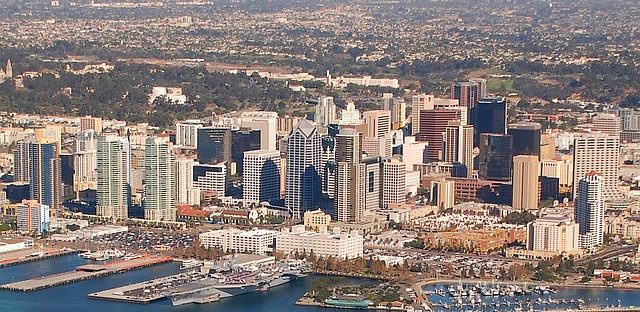
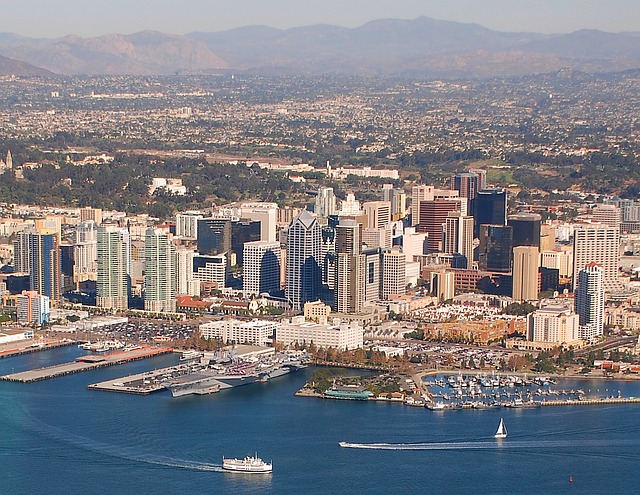
San Diego, California, USA

San Diego, California, USA

  • Target: 100% renewable energy on the city-wide electrical grid by 2035.
  • Status: In progress
  • RES: Renewable electricity purchasing.
  • Implementation: In 2015, the City of San Diego, California set the target of cutting GHG emissions in half and achieving 100% RE by 2035. The target was part of a comprehensive Climate Action Plan launched by Republican Mayor Kevin Faulconer. The plan was to also increase water and energy efficiency in buildings, intensify public transport, grow the number of electric vehicles, promote walking and cycling routes, zero-waste strategies and climate adaptation measures. The city would achieve the energy target through a Community Choice Aggregation (CCA) programme, which will enable it to purchase the electricity directly from various energy producers (gas, wind, solar, etc.) and sell it to residents and businesses. The power will be delivered to the consumers by the local utility SDG&E, which manages the power infrastructure, regulates the grid, and provides customer service, etc. The CCA programme differs from the past in that it allows the City of San Diego and its citizens to actively decide where their energy comes from. Previously, the utility had total control of the city’s energy supply, and conducted all the purchasing and selling of energy to consumers. Unlike the private utility model, the CCA programme is not for profit, and is run by the local government. Part of the revenue from energy sales that would normally flow into the private utility shares would now remain within the community budget. This available income can be used to fund local energy efficiency and renewable energy projects. The CCA will also give consumers greater choice by allowing them to optionally take part in the programme and to decide whether they would like to purchase their electricity from renewable energy sources or not.
  • Population: 1,307,402 (city), 3,317,749 (metro)(2010)
  • Area: 372.39 sq mi (964.50 km2)
  • Link: https://www.sandiego.gov/sites/default/files/legacy/planning/genplan/cap/pdf/CAP%20Adoption%20Draft%202015.pdf
San Diego, California, USA